
Jio Platforms Ltd's initial public offering (IPO), anticipated to be India's largest, is scheduled to open for subscription on October 21 and close on October 23, with reservations for employees and Reliance Industries Ltd shareholders.

Indian equity benchmarks Sensex and Nifty extended their losses for a third consecutive session, with the Sensex declining 460.30 points and the Nifty dropping 123.70 points, primarily due to surging crude oil prices driven by escalating tensions in West Asia and weak global cues.

Indian equity benchmarks Sensex and Nifty rallied up to 1 per cent in early trade, driven by strong performance in IT stocks, Reliance Industries, and favourable global market sentiment, rebounding from previous losses.

A foreign brokerage predicts that private investments in Indian AI startups are rapidly growing, with potential listings adding up to USD 100 billion to India's market capitalisation over the next two to five years. Goldman Sachs reported a tripling of PE investment in Indian AI startups in 2025 and highlighted India's rising global rank in AI funding and new AI companies.

Indian benchmark equity indices, Sensex and Nifty, significantly recovered from sharp early losses, driven by buying in State Bank of India and Reliance Industries, alongside fresh foreign fund inflows, despite declines in Axis Bank and HDFC Bank.

Indian mutual fund holdings in overseas equity securities increased by 37.5 per cent year-on-year to approximately '93,602 crore by March-end, according to RBI data. This growth is attributed to mark-to-market gains from a global market rally and heightened investor interest, with the US remaining the primary destination for these investments.
Indian benchmark equity indices, Sensex and Nifty, ended sharply lower, with the Sensex tumbling 876.37 points and the Nifty dropping below 22,900, primarily due to a decline in private bank stocks like HDFC Bank and Axis Bank, alongside weak global market trends.

Sustained selling by foreign investors is weighing on domestic equities, with the benchmark Sensex and Nifty 50 down 15.60 per cent and 14.4 per cent, respectively, this year.

Indian benchmark indices Sensex and Nifty closed lower, primarily due to declines in Reliance Industries and IT sector stocks, coupled with rising crude oil prices and investor caution ahead of the US Federal Reserve's policy decision.

'As a youngster, if you are not investing in yourself and your active income, you will not be able to reach the first 1 crore mark.'

Indian benchmark indices Sensex and Nifty experienced a significant drop in early trade, primarily due to a sell-off in IT stocks, a surge in crude oil prices, and investor caution ahead of the US Federal Reserve's policy decision.

The Indian Cabinet has approved Fairfax Financial Holdings' Rs 52,878 crore bid to acquire a 60.72 per cent stake in IDBI Bank, marking the country's largest foreign direct investment in the financial sector.

Foreign institutional investors have withdrawn nearly $40 billion from Indian equities in the last two years and, according to Bernstein analysts, have 'little reason' to invest for the long-term, though they may 'return to trade'. The brokerage highlights challenges such as struggling large-caps, disruption from new technologies, and difficulties accessing small- and mid-caps (SMIDs) at an institutional scale.
Indian equity benchmarks Sensex and Nifty experienced a decline in early trade, primarily due to a sell-off in power and metal stocks, mirroring a broader downturn across Asian markets. Elevated crude oil prices and firm US bond yields further dampened investor sentiment, while an expert warned of an impending correction in overvalued mid and small-cap segments. Track Sensex, Nifty on October 22.

Indian benchmark stock indices, Sensex and Nifty, closed lower due to profit-taking, a spike in wholesale price-based inflation, and firm crude oil prices, despite some support from easing intraday crude oil prices and rupee appreciation.

India's private equity (PE) industry is transitioning from a 'spray and pray' approach to a more selective investment model, focusing on established businesses, greater strategic influence, and operational transformation to generate definitive returns, according to industry leaders Renuka Ramnath and Amit Chandra.

Indian benchmark indices, Sensex and Nifty, closed flat on Friday, with elevated crude oil prices due to geopolitical uncertainties and a rebound in US Treasury yields making investors cautious and preventing a decisive market rally.
AI-managed services firm RapidCanvas, with a significant employee base in India, announced on Friday that it has raised USD 29 million (approximately Rs 275 crore) in Series B funding. The round was led by Vertex Ventures SEA and India, with participation from Hitachi Ventures and existing investors. The company plans to use the funds to expand its go-to-market teams, partner network, and grow its employee base and engineering teams in India, the US, and Brazil, while also investing in product development.

HSBC has emerged as the leading international bank in facilitating fundraising for Indian companies through bonds, syndicated loans, and IPOs during January-September 2026, according to Hitendra Dave, CEO of HSBC India.
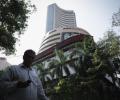
Analysts predict continued volatility in Indian equity markets due to domestic macroeconomic data, F&O expiry, global developments including US tariff policies, and geopolitical tensions.

'Every period of excessive optimism eventually gives way to a correction, while periods of extreme pessimism often create the best investment opportunities.'

Investors are set to monitor quarterly earnings, crude oil prices, the Jio Platforms initial public offering, and foreign investor activity in the upcoming holiday-shortened week, according to market analysts.

Foreign Portfolio Investors (FPIs) have injected Rs 16,621 crore into Indian equities during the first half of August, continuing a buying spree driven by improving relative valuations, resilient corporate earnings, and expectations of softer US interest rates.

Indian stock markets are set to be influenced this week by a confluence of factors including quarterly corporate earnings, the US Federal Reserve's interest rate decision, fluctuations in crude oil prices, and ongoing geopolitical developments in West Asia.
The United Forum of IDBI Officers and Employees has strongly opposed the proposed sale of a majority stake in IDBI Bank to Canada-based Fairfax Financial Holdings, demanding an immediate suspension of the process and a comprehensive review under parliamentary scrutiny.

Hockey India is embroiled in a significant internal dispute between President Dilip Tirkey and Secretary Bhola Nath Singh, primarily stemming from an unauthorised jersey colour change. An emergent Executive Board meeting has been called to address this conflict, discuss the restructuring of the Hockey India League (HIL) into a joint venture with franchises, finalise election dates, and deliberate on hosting Asian Champions Trophy events. The meeting also aims to address a show-cause notice issued to the Director General.

Both gold and silver investments have proved profitable in the last few years; however, there has been a marked difference in their behaviour. While gold has mostly provided smooth sailing, silver has seen volatility due to its strong association with industrial demand. In this scenario, a monthly SIP analysis provides insights into how both these investments have done over the years. An SIP differs from a lump-sum investment by making purchases at varying price levels, thus changing the overall yield dramatically.

Indian benchmark indices Sensex and Nifty traded lower in early sessions due to profit-taking and significant foreign institutional investor (FII) outflows, despite strong performance from IT stocks like Tech Mahindra. Track Sensex, Nifty on October 16.

Mukesh Ambani fought back tears as his three children, Akash, Isha, and Anant Ambani, took the stage at the stock market listing of Jio Platforms Ltd, marking an emotional moment that signals the next generation's readiness to lead one of India's largest corporate empires.

A sharp price fall alone does not justify averaging down.

After four consecutive months of withdrawals, Foreign Portfolio Investors (FPIs) injected Rs 20,200 crore into Indian equities in July, driven by attractive valuations, improving corporate earnings, and a more favourable global environment.

Indian government bond yields have recorded their worst losing streak in three decades, rising for the tenth consecutive week, driven by elevated crude oil prices and increasing global yields. The rupee also weakened, and India's foreign exchange reserves saw a significant decline.

DIIs invested $22.8 billion in Indian equities in Q2CY26.
A report by the University of Chicago's Energy Policy Institute projects approximately 15,800 additional heat-related deaths in India over the next six months due to the 'super El Nino' phenomenon. Globally, nearly 451,000 additional deaths are anticipated. Experts in India emphasize the need for swift action, including implementing Heat Action Plans and focusing on vulnerable populations, while also urging caution regarding model-based projections.

The tax treatment of equity savings funds makes them appealing, especially to investors in higher income-tax brackets.

Indian IT stocks have experienced their most significant weekly surge in 18 years, with the Nifty IT index climbing 11.72 per cent, as a global sell-off in AI-linked equities redirected investor attention towards India's IT services sector. This shift aligns with a JP Morgan report identifying India as a 'natural AI hedge' due to its large, liquid market and strong domestic institutional investor base.

Indian benchmark indices Sensex and Nifty experienced declines in early trade, ending a two-day rally, driven by a spike in Brent crude oil prices above USD 101 per barrel and investor caution ahead of the Reserve Bank of India's monetary policy decision. Track Sensex, Nifty on October 7.

'They allow people to enter and exit. And there is transparency. There is market infrastructure. There is technology. There is cyber security. And then there are enough enablers.'

Over a dozen mutual fund houses in India have temporarily suspended fresh subscriptions in their gold fund of funds (FoFs) and gold-silver FoFs, a move believed to be influenced by directions from the Securities and Exchange Board of India (Sebi) ahead of the festive season.

Hockey India is embroiled in a significant internal dispute between President Dilip Tirkey and Secretary Bhola Nath Singh, primarily over a controversial jersey colour change and the authority to call emergent meetings. An upcoming Executive Board meeting aims to address these differences, discuss the future of the Hockey India League (HIL) including its restructuring into a joint venture, finalise election dates, and deliberate on hosting Asian Champions Trophy events.
